
IWPG Highlights Women-Led Peace Education as a Key to Preventing Transnational Organized Crime at UNTOC COP13
2026.10.23
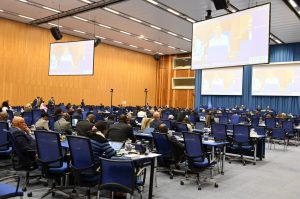
Transnational organized crime cannot be addressed through law enforcement and judicial cooperation alone. Preventing crime also requires tackling the conditions that leave communities vulnerable and strengthening their capacity to respond. At the 13th Conference of the Parties to the United Nations Convention against Transnational Organized Crime (UNTOC COP13), the International Women’s Peace Group (IWPG) highlighted the role of women-led peace education and community-based initiatives in preventing crime before it occurs.
Held at the Vienna International Centre (VIC) in Austria from October 19 to 23, 2026, the conference provided a platform for IWPG to deliver a statement during the plenary session and co-host an official side event. Through these engagements, IWPG emphasized that victim protection, women’s empowerment, and community resilience should complement judicial responses to transnational organized crime.
Beyond Punishment: Civil Society’s Role in Prevention
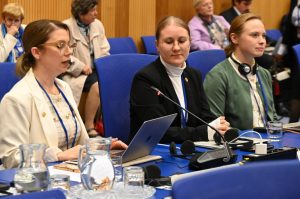
On October 22, during the plenary session on international cooperation, IWPG took the floor to speak on behalf of civil society. Lara Schmitt, Branch Manager of the IWPG Frankfurt Branch, identified two priorities that should accompany judicial action: a victim-centered approach and sustained investment in prevention and empowerment.
Schmitt emphasized that international judicial cooperation should contribute to protecting vulnerable people and restoring victims’ rights and dignity. She also stressed the importance of strengthening community resilience to address the underlying vulnerabilities that transnational crime exploits.
As a practical example, she presented the Peace Lecturer Training and Education (PLTE) program, which has involved 3,376 participants across 67 countries, according to IWPG. The program reflects the organization’s approach of supporting women as active participants in peacebuilding. IWPG argued that empowering local women to take part in peace initiatives can help communities become more resilient to crime.
Connecting Women, Peace and Security with Crime Prevention
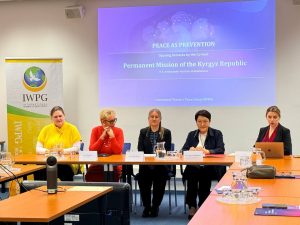
On October 23, IWPG co-hosted an official side event with the Permanent Mission of the Kyrgyz Republic to the United Nations in Vienna. Titled “Peace as Prevention: Women, Fragile Regions, and Transnational Organized Crime,” the event explored how the Women, Peace and Security (WPS) agenda, established through UN Security Council Resolution 1325, could be more closely integrated with efforts under the United Nations Convention against Transnational Organized Crime (UNTOC).
In her keynote address, Evelina Henriksson, Branch Manager of the IWPG Vienna Branch, emphasized that prevention begins long before a crime takes place. She pointed to peace education in local communities and support for women’s empowerment as important parts of that effort. Henriksson also shared key outcomes from the 2026 Global Women’s Peace Forum, held in July with approximately 1,000 participants from 46 countries.
Citing examples such as peace educator training at universities in Mexico and solidarity initiatives supporting vulnerable groups in Brazil, Henriksson stressed that women should not be viewed solely as victims of crime. Instead, they can play an active role in preventing it. She added that women-led peace education and leadership development can help address underlying factors that contribute to human trafficking and the recruitment of people into criminal organizations.
Nurzhan Shaildabekova, Ambassador of the Kyrgyz Republic and a co-host of the event, also highlighted the importance of local women leaders and civil society. She noted that these groups are often among the first to reach families facing crises, and argued that state-led law enforcement alone cannot prevent organized crime.
Shaildabekova shared examples from Kyrgyzstan, including women’s peace committees operating across approximately 20 regions and campaigns to prevent human trafficking. She emphasized that women-led peace education should be recognized as an important tool for crime prevention rather than a secondary consideration.
The event also featured Jana Merunková, director of the Czech nonprofit organization Your Chance (yourchance o.p.s.), who presented a case study on financial literacy education for vulnerable women. Her presentation illustrated how improving financial knowledge and skills can help reduce women’s exposure to crime.
Expanding International Cooperation for Prevention
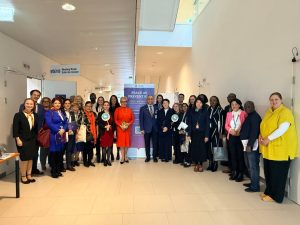
IWPG said its participation in UNTOC COP13 offered an opportunity to highlight women’s role in preventing transnational organized crime and to strengthen cooperation with international institutions and civil society organizations.
An IWPG official said the organization would continue working with the Permanent Mission of the Kyrgyz Republic, the United Nations Office on Drugs and Crime (UNODC) Civil Society Unit (CSU), and civil society organizations worldwide to develop policy recommendations and joint statements.
IWPG also outlined plans to expand its engagement at international forums, including the UN Commission on the Status of Women (UN CSW) in New York, the UN Human Rights Council in Geneva, and the African Union’s Pan-African Conference on Education for Women and Girls (PANCOGEd). Through these efforts, the organization aims to bring the experiences and concerns of women working on the ground to a wider international audience.
The discussions at UNTOC COP13 highlighted a broader approach to crime prevention: alongside judicial cooperation and law enforcement, communities need sustained investment in prevention, education, and women’s participation. IWPG’s message was that women-led peace education can be part of that effort by strengthening local communities and helping address the vulnerabilities that organized crime exploits.

Subscribe To Newsletter
We’d love to share everything we do with you. Sign up to stay informed.


