7,810 Children Around the World Draw Their Visions of Peace: Inside the 8th International Loving-Peace Art Competition Awards Ceremony
2026.11.14
The awards ceremony for the final round of the 8th International Loving-Peace Art Competition, hosted by the International Women’s Peace Group (IWPG, President Nayoung Jeon), was held online on November 14. From May to July this year, a total of 7,810 children and young people from 61 countries took part in the competition. Of the 80 artworks selected for the final round from 23 countries, 37 were ultimately chosen as award-winning works.
This year’s theme was “My Peace Story.” Participants used art to express what peace meant to them. Their works presented a wide range of perspectives, from harmony among family members and neighbors to understanding and respecting people with different backgrounds. Each artwork offered a personal reflection on peace, often rooted in everyday life.
The ceremony featured the announcement of awards in each category, along with interviews with the Grand Prize winner and the judges. The young artists shared the ideas behind their works and what they had learned through the competition, while the judges offered their perspectives on how children and young people understand peace. It was an opportunity for future generations from around the world to reflect on peace and share their stories through art.
More Than Artistic Skill: A Chance to Reflect on and Express Peace
First held in 2018, the International Loving-Peace Art Competition has been organized annually to give children and young people an opportunity to communicate through the universal language of art and grow as agents of peace. Now in its eighth year, the competition attracted 7,810 participants from 61 countries, each expressing their own “Peace Story” through art.
A total of 80 works from 23 countries advanced to the final round. The judges evaluated each entry based on its relevance to the theme, creativity, expressiveness, artistic quality, and ability to convey a message of peace. In total, 37 works received awards: one Grand Prize, four Gold Prizes, eight Silver Prizes, eight Bronze Prizes, and 16 Honorable Mentions.
The online ceremony brought together IWPG representatives, award-winning students from around the world, their parents and teachers, and education officials. Simultaneous interpretation was provided in nine languages—Korean, English, Indonesian, Chinese, French, Japanese, Mongolian, Czech, and German—allowing participants from different countries to follow the event together.
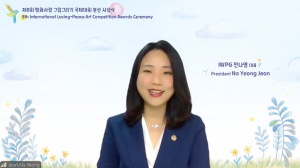
In her commemorative address, IWPG President Nayoung Jeon emphasized the values behind the competition. She explained that the event is not simply about judging how well participants can draw, but about how deeply they think about peace and how sincerely they express their thoughts through their artwork.
“What this competition looks at is not simply how well a picture is drawn, but how deeply the participants thought about the theme of ‘peace’ and how sincerely they expressed that heart on the canvas,” Jeon said. She described the competition as “a place of learning where participants first embrace peace in their hearts, rather than simply competing in artistic skill.”
She also likened the participants’ artworks to “seeds of peace,” expressing her hope that they would take root in the hearts of children and adults around the world and inspire hope for peace. “Peace is not something far away. It is an everyday choice that begins with me, and a form of happiness found in daily life,” she said.
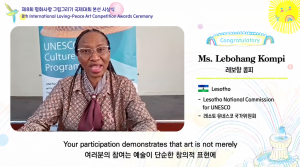
Lebohang Kompi of the Lesotho National Commission for UNESCO delivered congratulatory remarks through a video message. Kompi noted that art is more than a form of creative expression; it can serve as a powerful language for sharing hope, promoting mutual understanding, and inspiring positive change.
“We believe that peace is built through education, dialogue, mutual respect, and appreciation of cultural diversity,” Kompi said. He also praised IWPG for providing a valuable platform for young people around the world to share their visions of peace.
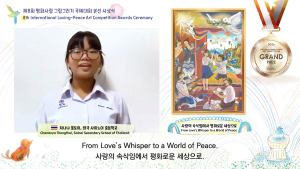
Finding Peace in a Traditional Thai Mural: The Grand Prize-Winning Work, “From Love’s Whisper to a World of Peace”
The Grand Prize-winning artwork combined traditional Thai mural techniques with modern art to portray mutual understanding and communication.
The Grand Prize, the competition’s highest honor, went to Chananya Thongthoi of Sainoi Secondary School in Thailand. Her work, “From Love’s Whisper to a World of Peace,” was recognized for its creative combination of traditional Thai mural techniques and modern art to convey the meaning of peace.
The inspiration came from a traditional Thai mural painting known as “The Whisper of Love” or “Pu Man Ya Man.” The painting depicts two people sharing a tender moment as they whisper words of affection to each other. Inspired by the scene, Chananya explored how love could become a starting point for peace. At the heart of her work is the idea that the world can change when people choose to whisper words of understanding instead of shouting at one another, and communication instead of violence.
“From Harmony at Home to World Peace”: What the Judges Saw in the Children’s Artwork
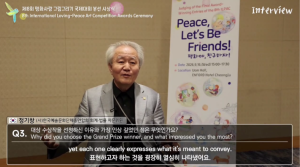
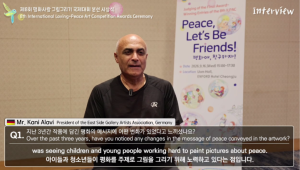
The final round was judged by Jeong Ki-chang, an advisor to the Federation of Artistic and Cultural Organizations of Korea, and Kani Alavi, President of the East Side Gallery Artists Association in Germany. Each judge brought a distinct artistic perspective to the evaluation, considering the participants’ understanding of the theme, their methods of expression, and the messages conveyed through their work.
Drawing on his experience judging numerous art competitions in Korea, Jeong spoke highly of the quality of the entries. He was particularly impressed by works that connected peace with harmony within the family. Alavi, who has served as a judge for the competition over the past three years, observed that the messages of peace expressed by participants had become clearer and stronger with each passing year.
We spoke with both judges about the meaning of peace they found in the artworks and the elements that stood out to them during the judging process.
37 Award-Winning Works: Indonesia Takes the Lead, with Four Awards for Korea
Of the 80 works that advanced to the final round, 37 were selected for awards. The awards comprised one Grand Prize, four Gold Prizes, eight Silver Prizes, eight Bronze Prizes, and 16 Honorable Mentions. The Grand Prize winner received a certificate and KRW 1 million. Gold Prize winners received KRW 500,000, Silver Prize winners KRW 300,000, and Bronze Prize winners KRW 200,000. Honorable Mention recipients received certificates.
By country, Indonesia had the highest number of award-winning entries, with eight works selected. The Czech Republic and the Republic of Korea tied for second place, with four awards each.
From the Czech Republic, the award recipients included Gold Prize winner Nella Bažatová, Silver Prize winner Klára Dušková, Bronze Prize winner Michaela Vadroňová, and Honorable Mention recipient Elspeth Logan. Notably, Otakar Ševčík Art School in Písek, Czech Republic, produced four award winners, with one student receiving an award in each of the four categories.
The Philippines received three awards in total: two Silver Prizes and one Honorable Mention. Over the eight years of the competition, the country has produced 12 major award recipients, reflecting its continued participation.
The Republic of Korea also had four award winners: two Silver Prize recipients, An Ye-sung and Kwon Na-ye, and two Honorable Mention recipients, Moon Ji-ah and Park Min-young.
37 Winning Works to Be Showcased in Exhibitions Across Seven Cities in Korea
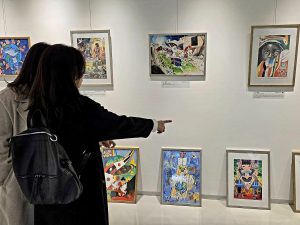
The artworks introduced at the awards ceremony are being shared with audiences through both online and in-person exhibitions. From October 24 to December 16, IWPG is holding a touring exhibition of the winning works in seven major cities across Korea.
Exhibitions in Chuncheon, at the Noktemare Media Art Exhibition Hall in Yeosu, and in Gunsan have already concluded. Further exhibitions are scheduled to take place in Incheon, Seoul, Daejeon, and Busan.
An online gallery is also available. Visitors can view all 37 award-winning works on the competition’s official website at any time and from anywhere. Those unable to attend an exhibition in person can still explore the visions of peace expressed by children and young people from around the world.
The artworks submitted to this year’s competition did not present peace as a single, fixed idea. They portrayed harmony within families, the willingness to listen to others, and the choice of dialogue over violence. Each participant expressed peace in a way shaped by their own experiences and hopes.
As Grand Prize winner Chananya put it, the world does not always need louder voices; it needs more people willing to listen. The stories shared through these artworks show that peace can begin in the relationships and choices of everyday life. Through their drawings, children and young people from different countries have shared their visions of peace—and invited audiences to reflect on how they, too, can put peace into practice in their daily lives.

Subscribe To Newsletter
We’d love to share everything we do with you. Sign up to stay informed.