[Peace Journey – Côte d’Ivoire ②] To Avoid Repeating the Tragedy of Elections
2024.11.27
While peaceful elections are the starting point of democracy, elections in Côte d’Ivoire have long been tied to memories of conflict and violence.
In every election held since 1990, political strife has escalated into violence, claiming the lives of countless citizens. In particular, women and children were particularly vulnerable during these conflicts and suffered deep wounds.
Another presidential election is drawing near.
The presidential election was scheduled for October 2025.
Faced with this upcoming election, Côte d’Ivoire chose a response different from its past approaches. Rather than attempting to contain conflict after it erupts, the country decided to nurture people who could learn about and practice peace beforehand. At the center of this initiative was the training of female peace leaders.
A Tragedy Repeated with Every Election
Political instability in Côte d’Ivoire deepened following the death of its first President, Félix Houphouët-Boigny, in 1993. Amid struggles for power, coups and armed clashes ensued, expanding political confrontation into widespread social unrest.
Efforts to restore stability through peace agreements continued, yet election-related conflicts never fully vanished.
The 2010 presidential election, in particular, left the deepest scar in modern Ivorian history.
Political disputes over the election results led to armed conflict, plunging the entire nation back into violence. Citizens lost their lives or were injured, and women and children could not escape the devastation.
This is why memories of the past resurface whenever an election approaches.
“What Must Be Done to Prevent Recurrence?”
Ahead of the October 2025 presidential election, the task facing Côte d’Ivoire was clear:
How could the election be prevented from becoming yet another starting point for conflict?
The Ivorian government identified education as one of the key solutions.
Resolving conflicts after they break out is insufficient to break the recurring cycle of violence. It was essential for members of society to learn about peace and conflict resolution, equipping themselves with the capacity to practice peace directly within their communities.
In this process, the role of women emerged as vital.
Women have historically acted as mediators and connectors in families and local communities, yet they lacked a sufficient voice in social decision-making and peacebuilding processes.
Thus, Côte d’Ivoire turned its attention to enabling women to step forward not merely as recipients of peace, but as active agents in building peace.
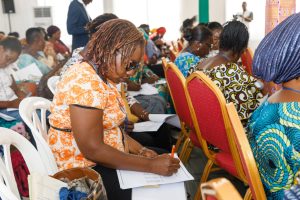
Côte d’Ivoire’s Choice: ‘Women’s Peace Education’
Under these circumstances, the Ministry of Women, Family, and Children (MFFE) of Côte d’Ivoire took note of the Peace Lecturer Training Education (PLTE) provided by the International Women’s Peace Group (IWPG).
IWPG’s PLTE is a program designed for female leaders to learn about the meaning of peace, the root causes of conflict, and ways to promote a culture of peace, enabling them to disseminate what they have learned within their local communities.
The Ivorian government recognized that if women become leaders who teach peace rather than simply learn about it, they can play a practical role in spreading a culture of peace across families, communities, and ultimately the nation.
Lamarane Barry, Deputy Chief of Staff at the Ministry of Women, Family, and Children of Côte d’Ivoire, also expressed his commitment to enhancing women’s rights through peace education and reducing gender-based violence and the loss of life resulting from election-related conflicts.
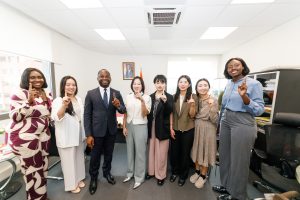
Heading to Abidjan Carrying the Seeds of Peace
The Ministry of Women, Family, and Children of Côte d’Ivoire finally extended an official invitation to IWPG.
November 23, 2024.
An IWPG delegation of 10 activists arrived at Abidjan Airport in Côte d’Ivoire.
Awaiting them were local female leaders gathered to learn about peace.
With the upcoming election ahead, a new endeavor began to ensure past tragedies would not be repeated.
What changes would unfold through this three-day training? And how would the women of Abidjan embrace peace?
In the next article, we will bring you the story of the first in-person Peace Lecturer Training Education (PLTE) held in Côte d’Ivoire and the 59 female peace lecturers who emerged from that training.
Next Story ☞ [Peace Journey – Côte d’Ivoire ③] Melodies of Peace Echoing Across Abidjan
Previous Story ☞ [Peace Journey – Côte d’Ivoire ①] A Peace Bond Beginning at the United Nations

Subscribe To Newsletter
We’d love to share everything we do with you. Sign up to stay informed.