[Peace Journey – Côte d’Ivoire ⑥] “We Must Learn Peace Just Like Mathematics”

2024.12.02

[Editor’s Note] Peace is not simply a declaration, but a change that begins between people. ‘Peace Journey’ records the stories of people who learn about and practice peace in communities around the world. The first journey is Côte d’Ivoire. Through the story of women’s solidarity and cooperation fostered through peace education, we trace how peace is built on the ground.

Peace is invisible, yet it is an indispensable prerequisite for a society to move forward. No matter how educated a population becomes or how much an economy grows, without safety and stability, it is difficult to safeguard those achievements.

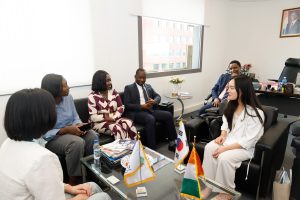
Moussa Diarrassouba, Cabinet Director at the Ministry of Women, Family, and Children (MFFE) of Côte d’Ivoire, who has spearheaded collaboration with the International Women’s Peace Group (IWPG), views peace not as a value to be learned only during special times, but as a fundamental form of education that should begin in early childhood. He emphasized that peace education should be naturally integrated into schools, just like mathematics or science.
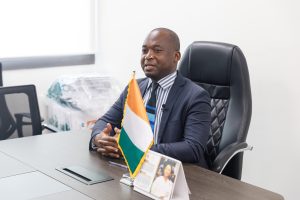
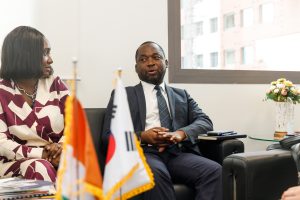
An Interview with Moussa Diarrassouba, Cabinet Director at the Ministry of Women, Family, and Children of Côte d’Ivoire

“A Great Mathematician Cannot Emerge from an Unsafe Environment”

When explaining the necessity of peace education, the first element Cabinet Director Diarrassouba emphasized was the “environment.” This means that education and development can only thrive in a peaceful society.

He noted that to build lasting peace, merely resolving conflicts after they erupt is insufficient. In particular, he stated that peace must be taught within the school curriculum from a young age so that younger generations can naturally internalize the values of peace, dialogue, and conflict resolution.

“We must study peace education today, just as we study mathematics or science. You cannot become a good mathematician in an unsafe environment.”

To him, peace education is not simply “a class that talks about peace.” It is about teaching the next generation the fundamental conditions needed for a society to develop sustainably.

The Unseen Power Possessed by Ivorian Women

He also emphasized the role of women in the process of building peace.

Having navigated past political and social crises, Côte d’Ivoire has experienced cycles of conflict and reconciliation. In those processes, women played a vital role in mitigating conflict and reconnecting communities, though he explained that such roles have often not been sufficiently highlighted.

Particularly within local communities, there exists a culture of seeking women’s advice when critical conflicts or disputes arise. Even if men appear to make decisions on the surface, in reality, women’s judgment within families and communities often has an influence on those decisions.

He saw the need to connect this influence with peace education.

When a single woman learns about peace, the impact does not stop with the individual. It can extend to her family, neighbors, and the broader community.

“When You Educate a Woman, the Family and Community Change”

Cabinet Director Diarrassouba stressed that cooperation with IWPG must not end with a one-time educational event.

He emphasized that in areas experiencing ongoing security issues, such as northern Côte d’Ivoire, or where inter-community conflicts exist, equipping women with the capacity to mediate conflict and contribute to peacebuilding is crucial.

Côte d’Ivoire has formulated its National Action Plan for United Nations Security Council Resolution 1325 on Women, Peace, and Security and is pursuing related policies. He noted that moving forward, these national policies must go hand in hand with efforts to empower women at the community level.

Rather than remaining limited to lectures and seminars, he hoped that collaboration with IWPG would evolve into programs and initiatives that could be actively implemented in local communities.

His perspective on the peace education initiated in Abidjan did not remain inside the classroom. He envisioned a future where women who received training return to their respective positions, resolve conflicts in their communities through dialogue, and help spread a culture of peace. 

From Learning About Peace to Building Peace

In November 2024, female leaders gathered for the peace education jointly organized by IWPG and the Ministry of Women, Family, and Children of Côte d’Ivoire. The training went beyond imparting knowledge, offering time for women to reflect on the roles they can play in their respective communities. At the time, Cabinet Director Diarrassouba similarly emphasized that strengthening women’s capacity to contribute to peace is directly linked to social stability.

In the next article, we will meet Lamarane Barry, Deputy Chief of Staff at the Ministry of Women, Family, and Children of Côte d’Ivoire, to hear why women’s participation is decisive in building peace and how empowering women and promoting their participation in policymaking can be connected to peace.

Next Story ☞ [Peace Journey – Côte d’Ivoire ⑦] “We Cannot Achieve Peace Without Women”

Previous Story ☞ [Peace Journey – Côte d’Ivoire ⑤] Women Gathering for Peace

Mail Icon

Subscribe To Newsletter

We’d love to share everything we do with you. Sign up to stay informed.
[영문] 뉴스레터 구독 폼