An Interview with Lamarane Barry, Deputy Chief of Staff at the Ministry of Women, Family, and Children of Côte d’Ivoire
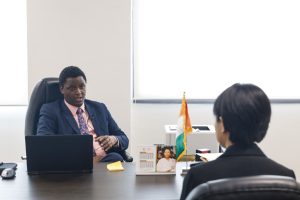
“We Cannot Build Peace Without the Participation of Women”
There is a background behind why Côte d’Ivoire places great importance on the role of women when discussing peace and social stability. When social conflicts, including elections, arise, women and children are heavily impacted.
Deputy Chief of Staff Barry believed that, in this reality, women must not remain merely victims of conflict. He advocated that women themselves must learn how to build peace and participate in local and national decision-making processes.
He saw IWPG’s peace education as significant precisely because it helps strengthen this role for women. In particular, he showed keen interest in the role women played in South Korea’s process of building peace after experiencing war and division, and how that experience could be applied to Côte d’Ivoire’s reality.
Laws, Institutions, and Women’s Capacity
To him, women’s peace education does not end with a single educational program.
Deputy Chief of Staff Barry explained that to build women’s capacity for peace, legal and institutional frameworks must first provide support. The Ivorian government’s formulation of the National Action Plan for United Nations Security Council Resolution 1325 on Women, Peace, and Security is part of such efforts.
The second pillar is women’s empowerment. Women must know their rights and be able to raise their voices within society.
The third pillar is expanding women’s participation in decision-making processes. He believed that women’s voices can bring greater balance to national and community discussions and contribute to resolving political and social conflicts through dialogue.
Ultimately, peace does not mean solely a state without war. Creating a society where women can participate in decisions that affect their lives and communities is also a crucial condition for peace.
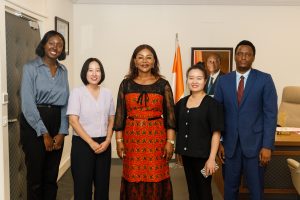
Women Learning About Peace, a Society Safeguarding Peace
To Deputy Chief of Staff Barry, IWPG’s visit to Côte d’Ivoire in 2024 carried a meaning beyond a simple educational program.
This was because he saw that the very process of women learning about peace, sharing their experiences with one another, and returning to their respective communities could serve as the beginning of a culture of peace.
In fact, the collaboration between IWPG and the Ministry of Women, Family, and Children of Côte d’Ivoire led to peace education for female leaders, with a focus on strengthening their capacity to contribute to peace and conflict resolution in their communities.
He hoped that this education would not remain a one-time event. He wanted to establish a structure through which more women could receive the education and, in turn, share what they had learned with other women and local communities.
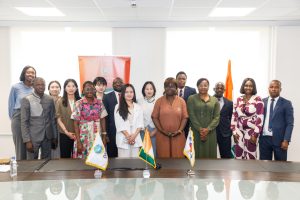
Collaboration Beginning in Abidjan, Moving to the Next Stage
Deputy Chief of Staff Barry emphasized the importance of ‘continued collaboration.’
He emphasized that if the encounter with IWPG had created an opportunity for Ivorian women to learn about peace, the scope of collaboration should be expanded so that this education could lead to tangible changes in the lives of women and their local communities.