[IWPC 2026④] Women Leaders from Conflict-Affected Regions Share Their Stories
2026.09.18
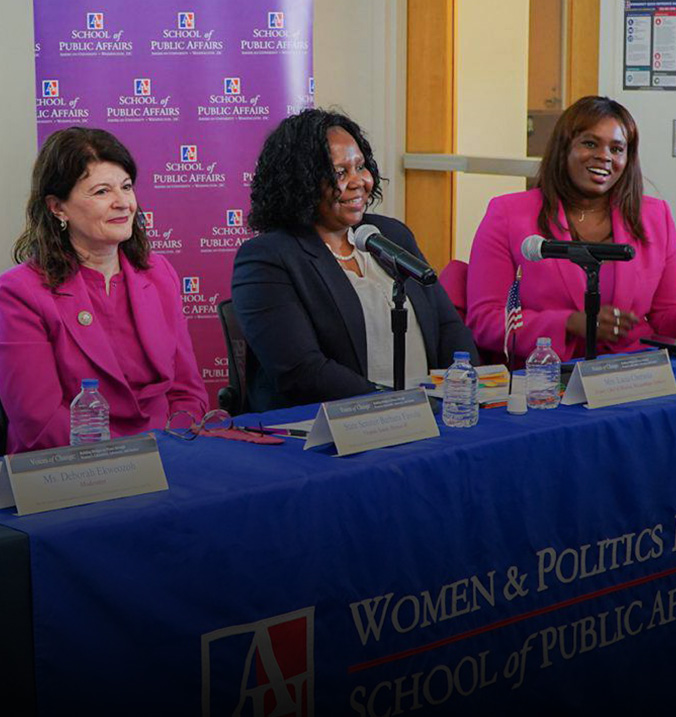
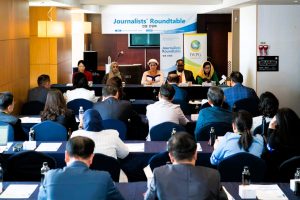
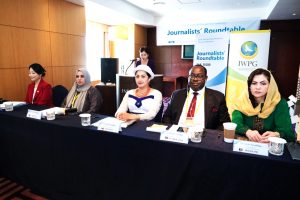
On September 18, domestic and international media representatives gathered in Cheongju alongside women leaders from around the world. The theme of the Media Roundtable was “Women’s Solidarity for Peace and the Role of the Media.”
Women leaders from Yemen, Ecuador, Kenya, and Afghanistan shared experiences of conflict, discrimination, and social division in their respective communities. Drawing on their experiences, they discussed what needs to be rebuilt after conflict, how the voices of women and other marginalized groups can be reflected in decision-making, and what can be done to prevent hatred and division from escalating into violence.
🕊 Everyday Life Does Not Return Automatically When War Ends
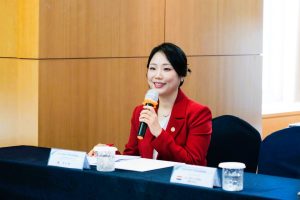
The first speaker, Jeon Na-yeong, President of IWPG, addressed the role of the media in promoting women’s peace and participation. She argued that coverage of conflict should go beyond casualties and destruction to also document the process of recovery that follows.
“The media does not merely record events; it shapes how people perceive reality. Press coverage of international conflicts must spotlight not only clashes and damage, but also the processes of halting conflict, restoring communities, and the possibilities of peace,” President Jeon said.
“This is not about ignoring conflict, but about presenting a more complete picture of reality. It is necessary to show how people repair relationships, rebuild lives, and move toward peace alongside the tragic aspects,” she added.
She also called for a broader understanding of women’s roles in conflict and peacebuilding.
“IWPG’s viewpoint is that women should not be viewed solely as victims of war and conflict, but as active agents who mediate disputes, reconnect shattered communities, and build peace in daily life,” President Jeon said.
Dr. Ahad Mohammed Salem Gaasos, Minister of State for Women’s Affairs of Yemen, also discussed peace in terms of restoring everyday life.
In her presentation, “Restoring Everyday Life from the Battlefield: Local Administration and Women’s Governance in the Yemeni Civil War,” Minister Gaasos explained that peace does not begin simply when fighting stops. Schools and health centers must reopen, public services and infrastructure must be restored, and people must once again feel safe in their communities.
“Women are not mere victims; they possess the power to solve problems and heal society,” she said, calling for women to be recognized as active partners in peacebuilding and social reconstruction.
She also stressed that women’s participation should be substantive rather than symbolic, calling for meaningful participation in local councils, public institutions, community initiatives, and dispute-resolution processes.
Among the priorities she identified were strengthening local administrative capacity, ensuring women’s substantive participation in decision-making, and promoting responsible journalism that also highlights peace and recovery.
Addressing the media, Minister Gaasos said, “Yemen is, above all, a society desperately longing for life.”
She argued that Yemen should not be defined solely through war, casualties, displacement, and crisis. Media coverage, she said, should also show working women, children attending school, young people dreaming about the future, and communities supporting one another through hardship.
“The peace we desire is not simply a pause in fighting. It means a society where children go to school, the sick receive timely medical care, families live in safety, women participate in decision-making, and young people can dream of a future in their homeland. Only when such everyday life returns can we say that true peace has begun in Yemen,” she said.
🏛 Taking Part in Decision-Making Without Giving Up Identity
From Ecuador, the discussion turned to creating a society where identity—as both a woman and an Indigenous person—does not become a barrier to political participation.
Ing. Diana Caiza, Mayor of Ambato, Ecuador, shared her political journey and approach to inclusive leadership in a presentation titled “An Indigenous Female Mayor Breaking the Glass Ceiling: Peace through Diversity and Inclusion.”
Elected in 2023 as the first female and Indigenous mayor in Ambato’s history, Mayor Caiza described facing prejudice, stereotypes, and barriers that sought to silence her as she entered politics.
“Breaking the glass ceiling does not mean merely having one woman reach the highest office. It means transforming societal structures so that women can overcome those barriers without sacrificing their identity, language, traditions, or community,” she said.
She also emphasized that peace should not be defined simply as the absence of war.
“True peace is not simply the absence of war,” Mayor Caiza said, stressing the need for a society in which no one is discriminated against or excluded because of their background, gender, or cultural heritage.
She explained that the experiences of groups that have historically been underrepresented—including women, Indigenous people, rural residents, and young people—need to be reflected in public policy.
To achieve this, she proposed expanding educational and leadership opportunities from childhood, increasing women’s substantive participation in politics, the economy, and communities, and creating structures in which one woman’s success can open opportunities for others.
Mayor Caiza stressed that her experience should not remain an isolated exception.
“A broken glass ceiling holds true meaning only when it becomes a new window through which all women can look out onto a wider world and advance without hesitation,” she said.
🛑 Preventing Hate, Division, and Conflict Before They Escalate
From Kenya, the discussion focused on social cohesion and the importance of identifying and responding to early warning signs before conflict develops into violence.
Dr. Kefa N. Omae, Chairman of Kenya’s National Cohesion and Integration Commission (NCIC), presented on “Beyond Division and Hate Speech: Strategic Leadership for Social Cohesion.”
Dr. Omae explained that the NCIC was established following Kenya’s post-election violence in 2007–2008, when approximately 1,300 people were killed and around 650,000 were displaced.
He noted that in a society where communities with different languages and cultural backgrounds coexist, political competition can lead to mobilization along ethnic and linguistic lines, while hate speech and incitement can further intensify tensions between communities.
He therefore emphasized the need for responsible language among political actors, greater participation by women and young people, and stronger responses to disinformation and hate speech in digital spaces.
In particular, he called for young people to be engaged not as instruments of conflict but as active participants in peacebuilding. The NCIC is developing young people as peace ambassadors and supporting efforts to counter fake news, misinformation, disinformation, malinformation, hate speech, and incitement online.
He also introduced an approach in which women, young people, and students participate in an early warning system to identify potential conflicts at an early stage. The aim is to detect and respond to warning signs before violence erupts rather than dealing with the consequences afterward.
Dr. Omae further stressed the importance of cooperation among religious leaders, civil society organizations, and government institutions, noting that social cohesion cannot be achieved by any single group alone.
He said the media, religious leaders, public officials, the international community, development partners, civil society organizations, and citizens all have a role to play in protecting the foundations of a peaceful society.
Fawzia Koofi, President of the Afghan Women’s Coalition, also called for a shift in how the international community and media portray women in post-conflict societies.
She noted that the rights of women and girls to education and social participation have been severely restricted since the Taliban returned to power. At the same time, she stressed that Afghan women should not be defined solely as victims.
“We are not victims; we are survivors,” Koofi said.
She described ongoing efforts to reclaim democracy and women’s rights through continued dialogue with women inside and outside Afghanistan, as well as through online educational opportunities for women in exile.
“Restoring democracy in Afghanistan is vital to the security of Asia and the international community,” she said, appealing to the Korean people for solidarity with Afghan women.
“The people of Afghanistan deserve a better life than what they have now. Peace in Afghanistan is peace in the world,” she said.
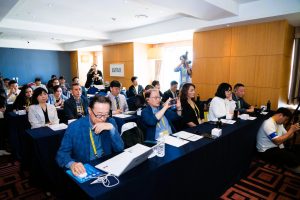
Following the presentations, women leaders and journalists continued their discussions through questions and answers on women’s human rights in conflict-affected areas, political participation, community recovery, and media coverage. Individual interviews and networking followed, allowing journalists and participants to exchange more detailed experiences from the field.
Next Story ☞ [IWPC 2026⑤] Women’s Leadership and Future Generations: Formulating the “Global Women’s Peace Recommendations”
Previous Story ☞ [IWPC 2026③] From ‘Peace Committee’ to ‘Peace Chapter’: A New Framework for Local Peace Activities

Subscribe To Newsletter
We’d love to share everything we do with you. Sign up to stay informed.